How to Get Ready for Your Roll-Off Dumpster Delivery
By DumpsterX Rentals · Updated · 6 min read
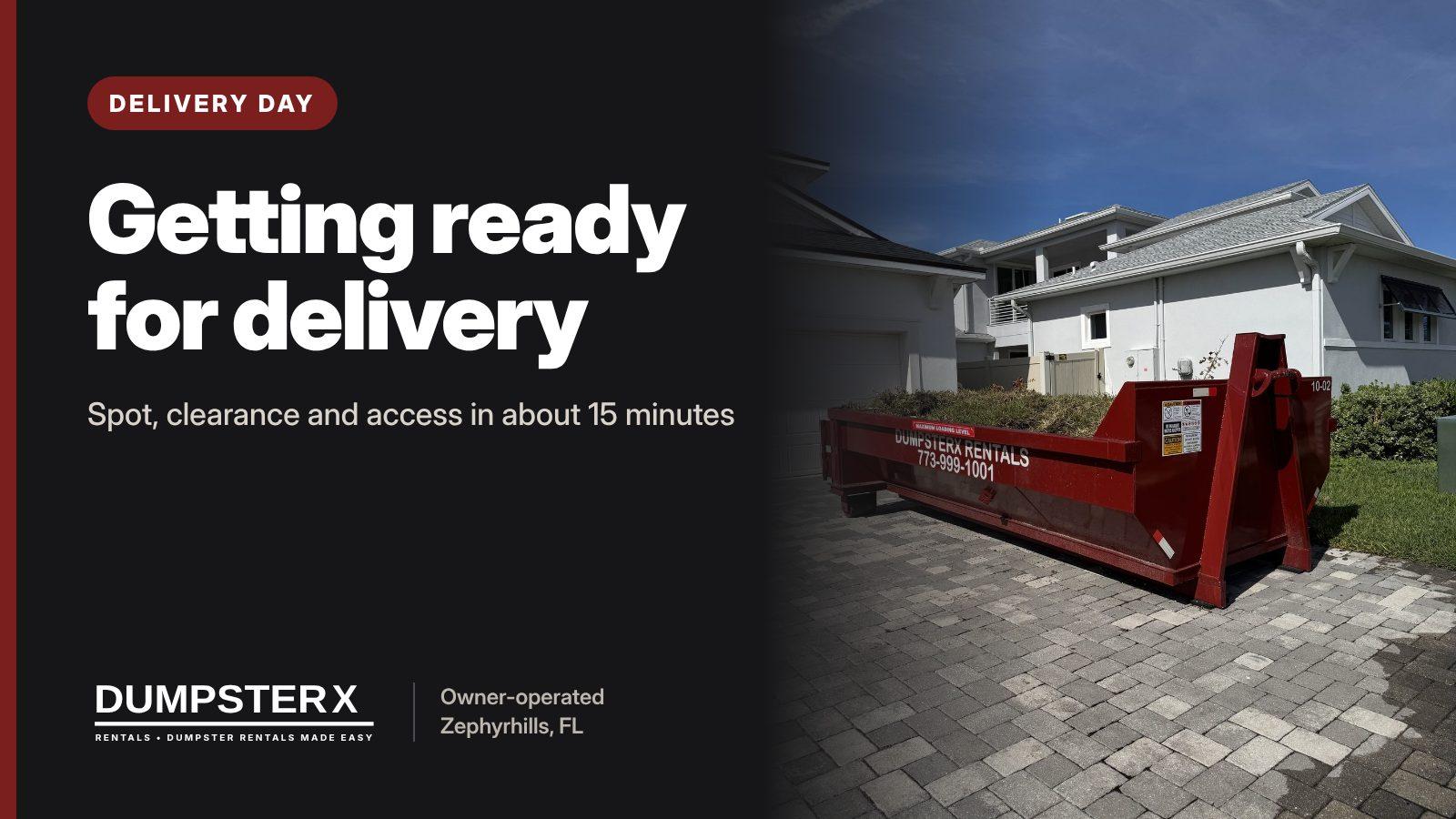
Prep takes about 15 minutes. Clear the spot you want the dumpster in, move every car that could get boxed in, look up for wires and branches, and send us the gate code if there is one. That covers almost every delivery we do.
We're owner-operated out of Zephyrhills, so the person who answers your call is the person backing the truck into your driveway. Here's what we need from you, and what happens when we pull up.
Step 1: Pick the exact spot
You choose where it goes. Walk out to your driveway before delivery day and decide on the actual square of ground you want the bin sitting on, then picture yourself carrying a bathroom vanity to it. Most people put it as close to the work as possible and forget they still need to get a car out on Monday morning.
A few things worth thinking through:
- Which end is the door? Every roll-off has a swinging back door so you can walk debris in instead of lifting it over the wall. Point that end toward your pile.
- Flat and firm. Level concrete or asphalt beats soft grass, especially after a wet week.
- Straight shot in. Our truck backs in and slides the box off. A straight approach is much easier than a tight curved driveway with a mailbox on the corner.
If you're not sure the spot will work, text us a photo of the driveway at (727) 699-1001 before delivery day. Ten seconds of looking at a picture saves both of us a headache.
Step 2: Move the cars
Everything out of the driveway, and out of the space the truck needs to swing into it. That includes the boat, the trailer, the trash cans on pickup day, and the neighbor who parks halfway across your apron.
This is the one that costs money. If we arrive and the driveway is blocked, we can't unload, and a $150 trip fee may apply for the wasted run. Same on pickup day. Any honest hauler will tell you the same thing, because the truck still burned the fuel and the time.
Step 3: Measure your clearance
Two measurements matter: how much room the bin takes on the ground, and how much room the truck needs in the air.
| Size | Dimensions (L x W x H) | Flat price, 3 days | Weight included |
|---|---|---|---|
| 10 yard | 14 ft L × 7.5 ft W × 2.5 ft H | $350 plus tax | 1 ton |
| 17 yard | 16 ft L × 7.5 ft W × 4 ft H | $420 plus tax | 2 tons |
| 22 yard | 18 ft L × 7.5 ft W × 5 ft H | $480 plus tax | 2 tons |
| 30 yard | 19 ft L × 7.5 ft W × 6 ft H | $590 plus tax | 3 tons |
On the ground
You need the length of the bin from the table plus the length of the truck, in a reasonably straight line. Measure the whole run, not just the box. The bin doesn't drop straight down; it rolls back off the rails, so the truck needs runway behind it.
Overhead
This is the one people miss. When the box comes off, the front of it lifts high above the cab. Think two stories of vertical room, not one. Walk the path and look up for:
- Power, cable, and phone lines crossing the driveway
- Low oak and pine branches
- Carports, porch overhangs, and second-story balconies
- Basketball hoops and gate arches
If a branch is in the way, trim it before delivery day or pick a different spot. We won't force a bin under something that's going to get pulled down.
Step 4: Send the access notes
Gate code, call box number, a locked side gate, a dog in the yard, a gated-community guard shack that needs a name on the list, a neighbor's fence you'd rather we didn't clip. Put all of it in the notes when you book online, or just say it on the phone. Same-day delivery may be available depending on dumpster availability and your location, and clean access notes are what make that possible.
Why the street usually isn't an option
For residential jobs, plan on the driveway or your own private property. Street placement usually is not allowed, and it isn't us being difficult: a loaded roll-off sitting in a public right-of-way is a different conversation with your city or county than a bin sitting on your own concrete.
If your driveway truly won't work, call us and describe the property. Sometimes there's a side yard, a pad, or a spot behind the house that solves it.
What happens when we arrive
- We walk the driveway together. You point at the spot, we look at the approach and the overhead, and we tell you straight if we see a problem.
- Payment before delivery. Payment is required before we deliver, so nothing is outstanding on the day.
- We set it exactly where you asked. Steel on concrete is steel on concrete, so if there's a section of driveway you're protective of, say so during the walk and we'll put the bin somewhere else.
Protecting your driveway
A roll-off dumpster is a steel box with steel rails, sitting on your driveway for a few days. A few honest tips:
- Pick your strongest surface. Thick concrete or asphalt handles a bin best. Tell us about any section that's new, cracked or that you're protective of, and we'll place it somewhere else.
- Avoid freshly poured concrete. If the driveway is new, ask your concrete contractor how long to wait before heavy loads.
- Pavers: say so when you book, and point out the spot during the walk-through.
- Grass and dirt: fine when the ground is dry and firm. After a week of Florida rain, soft ground can rut, so a hard surface is safer.
Loading tips that save space and money
- Use the back door. Walk big or heavy items in rather than lifting them over the wall.
- Heavy and flat first. Spread dense material across the floor of the bin, not piled at one end.
- Break things down. Take legs off tables, cut up carpet, flatten boxes.
- Fill the gaps. Toss bags and small debris in last to fill the spaces between big items.
- Stop at the top rail. Nothing can stick up above it. An overloaded bin has to be leveled before we can haul it.
HOAs, gated communities and the office
If you live in an HOA neighborhood, a 55+ community or a gated park, check whether they have rules about dumpsters, and let the office or gate know a truck is coming. Give us the gate code or guard instructions in your booking notes. It's the most common thing that slows a delivery down.
While it's here
Three days are included. Extra days are $25 each. Load it level with the top rail so it can be legally tarped and hauled. Overage past your included weight is $120 per ton, prorated by the pound off the landfill's certified scale ticket, and you get a copy of that ticket.
Keep out wet paint, batteries, hazardous chemicals and liquids, asbestos, food waste, and flammable materials. TVs and tires are fine with a $25 per-item disposal fee. Concrete, dirt, brick, and block need prior approval and go in our heavy-material bin. Roofing tear-offs go in the 10 or 17 yard only, never the 22 or 30, because shingles get too heavy to haul legally.
Not sure which size fits your project? Compare them on our sizes and pricing page, check the roofing guide if you're tearing off shingles, or read the FAQ.
When you're ready, call or text (727) 699-1001 or book online, and we'll walk your driveway with you when we get there.
Common questions
How much space do I need for a dumpster?
The bin is 7.5 feet wide and 14 to 19 feet long depending on size. The truck also needs a reasonably straight run behind the spot and plenty of overhead clearance when the box comes off.
Will a dumpster damage my driveway?
We place it carefully exactly where you choose. Pick your strongest surface, and tell us about any new, cracked or paver sections so we can avoid them.
Can the dumpster go on the street?
For residential jobs, plan on the driveway or your own property. Street placement usually isn't allowed.
Can the dumpster go on my grass?
On dry, firm ground it can. After heavy rain, soft ground can rut under the weight, so a hard surface is safer.
What is the trip fee?
If we arrive and can't deliver or pick up because the spot is blocked by a car, a gate or a low branch, a $150 trip fee plus tax may apply.
How full can I load the dumpster?
Level with the top rail. Nothing can stick up above it, so the load can be tarped and hauled legally.
Questions about your project? Call or text (727) 699-1001 or book online.